
For most monthly and annual subscriptions, a 7-day trial is the safer first choice. It beats a 3-day trial on conversion, on early cancellations and on renewals in the data I found. For weekly plans the gap is small, so test it.
There is one catch. I found no public study that compares exactly 3 days with exactly 7 days. RevenueCat, a company that sells subscription tools, groups trials into “4 days or less” and “5 to 9 days.” A 3-day trial sits in the first group and a 7-day trial in the second. So the numbers below are close proxies, not a head-to-head test.
1. Which length converts more people?
The chart below compares the two closest groups. Each number is the median share of trial users who become paid subscribers:
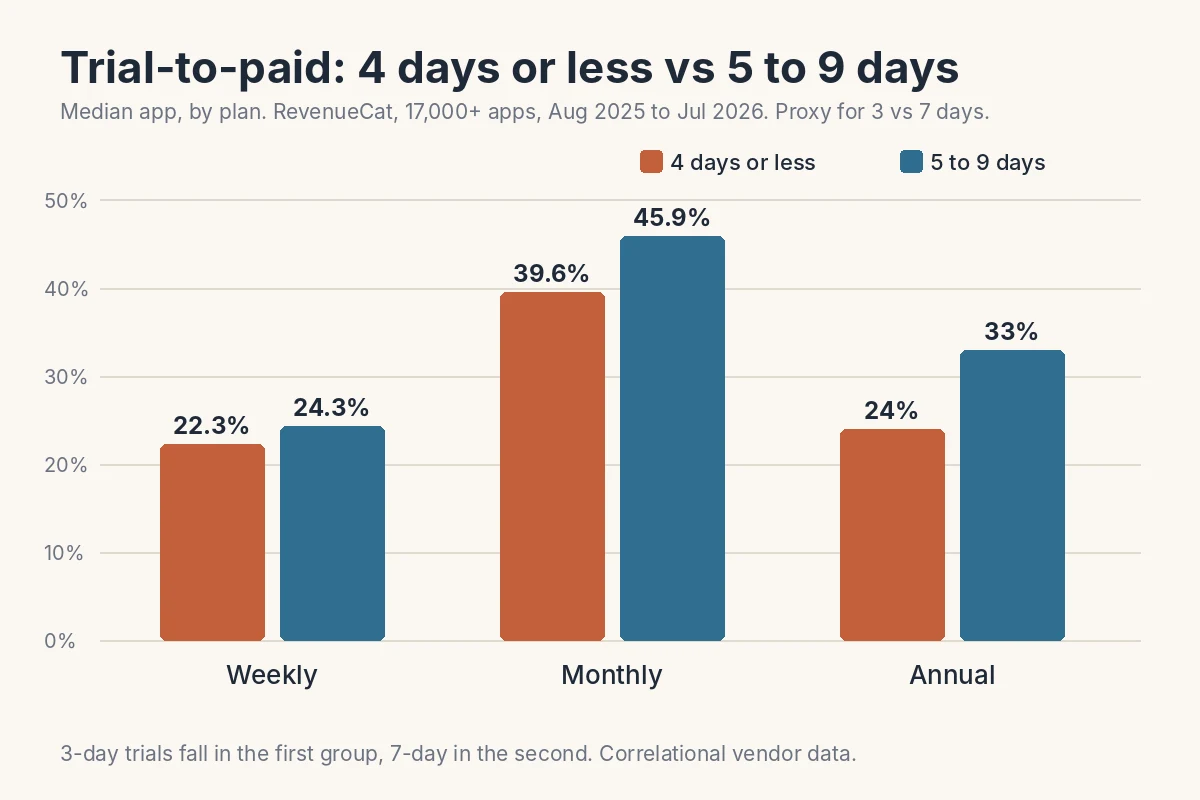
The 5 to 9 day group wins on every plan type. The gap is large for annual (9 points) and monthly (6.3 points) and small for weekly (2 points). RevenueCat also notes that evidence for longer trials on weekly plans “remains limited,” and that weekly estimates rest on fewer apps.
The pattern is not universal:
- AI apps on weekly plans: 22.3% for 4 days or less and 23.1% for 5 to 9 days, almost a tie.
- Health and Fitness, monthly: 5 to 9 days converts at 46.8%, which beats 10 to 16 days at 40.4%.
- Middle East and Africa, India and South-East Asia, and Latin America, monthly: conversion peaks at 5 to 9 days.
2. When do people cancel?
Short trials lose people fast. RevenueCat’s State of Subscription Apps reports what share of all cancellations happen on day 0, the day the trial starts:
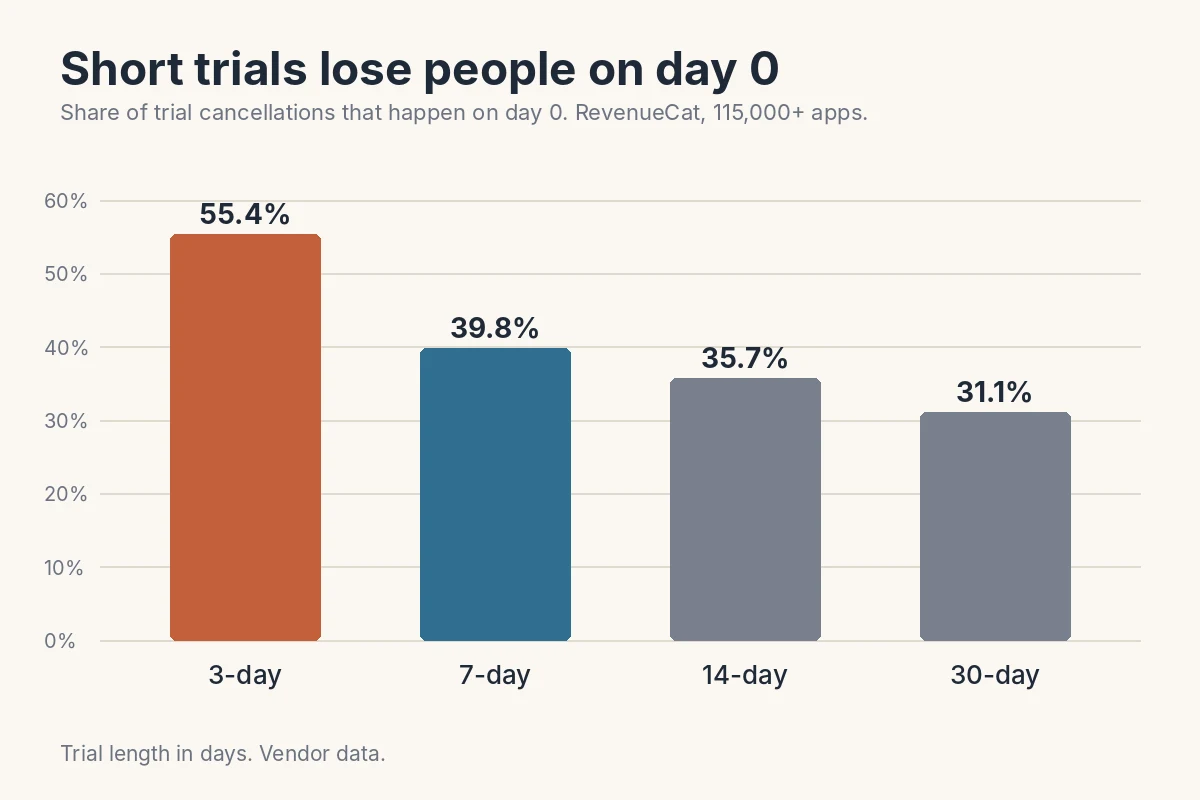
The same report says 84% of 3-day trial cancellations and 64% of 7-day trial cancellations happen between day 0 and day 1. A 3-day trial gives the user very little time to see your value.
3. Who stays and pays again?
This is the first renewal among people who paid after the trial (RevenueCat’s trial study, median app):
| Plan | 4 days or less | 5 to 9 days | Gap |
|---|---|---|---|
| Weekly | 57.9% | 65.9% | 8.0 points |
| Monthly | 54.2% | 62.8% | 8.6 points |
| Annual | 18.3% | 25.3% | 7.0 points |
Take care reading this. It counts only people who paid, not everyone who started a trial. RevenueCat says that is why the numbers “run higher.” It also warns that people who convert after a longer look “might already be the ones less likely to cancel.” So some of the gain comes from who stays, not from the trial itself.
On the full count of trial users who paid and renewed once, weekly plans reach 14.4% with a 5 to 9 day trial against 11.8% with 4 days or less.
4. What most apps do, and what Apple allows
Top weekly-plan apps lean heavily on short trials. RevenueCat’s trial study says 81% to 100% of the top weekly apps use 4 days or less, depending on category. For monthly and annual plans, top apps lean toward 9 days or less, with Education, Health and Fitness, and Travel favouring 5 to 9 days.
The RevenueCat article also says weekly plans often use 3-day trials because a full free week “essentially devalues the subscription.” That is the company’s opinion, not a measured result. Its main advice is to match the trial to how long your app takes to show value, not to a habit: 3 to 7 days for simple, quick-value apps, 7 to 14 days for daily-use apps.
Apple lets you pick either length. Free trials can be 3 days, 1 week, 2 weeks, or 1, 2, 3 or 6 months, per Apple’s introductory offer page. Each person gets one introductory offer per subscription group, and you cannot edit an offer once it exists: you delete it and make a new one.
5. How to choose for your app
This is my advice, built from the data above.
| Your situation | Start with | Why |
|---|---|---|
| Monthly or annual plan | 7 days | Higher conversion and first renewal than the 4-day group in RevenueCat’s data |
| Weekly plan | Test 3 vs 7 days | The conversion gap is only about 2 points |
| Your app shows value on day 1 | 3 days is reasonable | Users may not need longer |
| Your app builds value over several days | 7 days or more | Cancellations bunch up early when value is not yet clear |
| You sell in India, South-East Asia, Middle East, Africa or Latin America | Start at 7 days, do not go much longer | Monthly conversion peaks at 5 to 9 days there |
6. How to test it yourself
RevenueCat’s numbers are a guide. Your own users decide. A simple test:
- Change one thing only. Same price, same paywall, same plans. Only trial length differs (3 vs 7 days).
- Split new users at random. Do not compare this month to last month.
- Wait for enough trials. RevenueCat calls any group with fewer than 20 apps “directional,” so small samples are weak even for them. My advice: use about 100 trials per version as a floor.
- Measure three things: trial-to-paid conversion, share who cancel on day 0, and first renewal. Pick the winner on paid users who renew, not on trial starts.
- Run past the first renewal. A monthly plan needs at least one full billing cycle to show retention.
Five mistakes to avoid
This is my advice, based on the sources above.
- Treating a proxy as proof. The data compares 4 days or less with 5 to 9 days, not 3 with 7.
- Copying what big apps do. The study samples the top 100 apps in each group. Your users may differ.
- Counting trial starts as success. More starts can mean more people who cancel on day 0.
- Changing the trial and the price together. You cannot tell which one worked.
- Stopping the test too early. Renewal data arrives weeks after the trial ends.
What to do next
This week: set a 7-day trial on your monthly and annual plans. If you sell weekly plans, split users between 3 and 7 days. Check results after each version passes about 100 trials, and read renewals before you pick a winner.
How I wrote this?
- I read RevenueCat’s free trial length study (17,000+ apps on the App Store and Google Play, August 2025 to July 2026). It uses the top 100 apps by trial starts in each category and plan length, and reports median rates.
- I read RevenueCat’s State of Subscription Apps 2026 (115,000+ apps) for cancellation timing.
- I read a RevenueCat article, “The right trial length isn’t 7 days” (19 March 2026), and Apple’s introductory offer rules.
- I did not run a trial test. All figures are RevenueCat’s. They are vendor data and correlational: apps that pick a trial length may differ from apps that do not.
- Lines marked My advice are my judgement, not data.